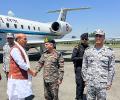
Defence Minister Rajnath Singh on Thursday questioned the safety of nuclear weapons in the hands of Pakistan, and said they should be taken under monitoring of the International Atomic Energy Agency.

Emotional scenes were witnessed across the country as the last rites of those killed in shelling by Pakistan during the recent military conflict with India were performed on Sunday.
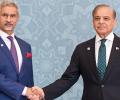
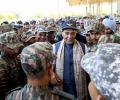
Shehbaz made the comments during a visit to the Kamra air base in the country's Punjab province where he interacted with officers and soldiers involved in the recent military confrontation with India.

'Even known names and social media handles went berserk by stating that Karachi has been attacked and an F-16 was shot down.'

Over 100 terrorists, including high-value targets such as Yusuf Azhar, Abdul Malik Rauf and Mudasir Ahmed, were eliminated during Operation Sindoor on May 7, the Indian military said on Sunday.
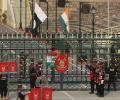
In the India-Pakistan situations, off-ramps have come either through foreign mediation (after months of kinetic warfare over Kargil, and a long stand-off with Op Parakram) or when a situation made it possible for both sides to claim a win, explains Shekhar Gupta.
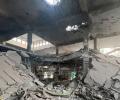
'This operation was a culmination of such long (period) of efforts, and gives us satisfaction that whatever we have been doing, we have been doing correctly'
Dar's statement, echoed by another federal minister, came as the Indian and Pakistani militaries targeted each other's installations using missiles in the last more than 12 hours, further escalating the already tense conflict situation.
'Pakistan is no longer a front-burner issue for America.'

Wing Commander Pratap Marathe's story is one of dedication, bravery, and humour, a shining example of the spirit of the Indian Air Force. Air Commodore Nitin Sathe (retd) salutes Wing Commander Marathe who passed into the ages last week.

Pakistan fast bowler Haris Rauf has been fined 30 per cent of his match fees for abusive behaviour and making an aggressive gesture during the high-voltage Asia Cup clash against India, tournament sources confirmed.

He said China's "growing imprint" will surely increase contestation and competition in the economic domain and it will attempt to keep India engaged on issues relating to the unsettled borders.

Pakistani combat jets pounded militant bases in the lawless North Waziristan tribal region, including the home of Taliban commander Adnan Rashid, and killed 25 terrorists in retaliation for a string of attacks on security forces.
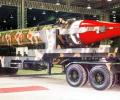
The US intelligence assessment highlights Pakistan's near-certain procurement of weapons of mass destruction-applicable goods from foreign suppliers, primarily through Chinese support.
In a strong retaliation to the Pahalgam massacre, India's armed forces early Wednesday destroyed nine terror sites including that of Jaish-e-Mohammad and Lashkar-e-Taiba in Pakistan and Pakistan-occupied Kashmir (PoK) using deep strike missiles in a 25-minute-long 'measured and non-escalatory' mission.

India's Air Chief Marshal A P Singh met Prime Minister Narendra Modi on Sunday to discuss the security situation arising from escalating tensions with Pakistan. The meeting comes after a similar briefing by the Navy Chief on the situation in the Arabian Sea. This follows a deadly terror attack in Pahalgam, which India has blamed on Pakistan. India has taken several retaliatory measures, including suspending the Indus Waters Treaty and banning imports from Pakistan.
The sources said Misri reiterated the government's stand that the decision to stop military actions was taken at a bilateral level, as some opposition members questioned US President Donald Trump's repeated assertions about his administration's role in stopping the conflict.

The DGCA official who wrongly assigned the code of Antonov AN-32 -- an aircraft used by the IAF -- to the SpiceJet aircraft has been suspended, report Arindam Majumder and Aneesh Phadnis.

MiG-21s are one of the oldest aircraft in the Indian Air Force fleet. Most of them are on the verge of being phased out from the inventory of the air force.

India strongly rejected Pakistan's 'unwarranted aspersions' over United Nations processes and attempts to deflect attention from atrocities committed against children in the country and rampant cross-border terrorism, asserting that the world has not forgotten the Pahalgam attacks.

The IAF C30J aircraft is carrying the bodies of the Indians and of them 31 were received at the airport in Kochi.

A villager was killed and three others were injured in shelling by Pakistan in forward areas of Jammu and Kashmir's Poonch and Rajouri districts early Friday morning, prompting Army troops to retaliate. The shelling also caused significant damage to property, with many houses and hundreds of vehicles affected. The firing and shelling were directed at areas in Rajouri, Poonch, and Jammu districts, apart from Kashmir's Kupwara and Baramulla districts, overnight.
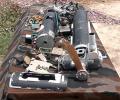
The Indian Army used Medium Machine Guns (MMGs) to target Pakistani Army forward posts along the Line of Control (LoC), inflicting heavy casualties during a ceasefire violation on the intervening night of May 7-8.

'The background for the Saudi-Pakistan agreement is the fact that the regional security order has collapsed due to the Israeli attack on Doha.' 'The Americans have largely abandoned their security guarantee for West Asia and the region has no choice but to look at alternatives.'
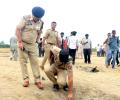
Indian Armed Forces brought down a number of these drones using kinetic and non-kinetic means.

More than 300 flights have been cancelled and at least 25 airports, including Srinagar, have been temporarily shut for operations amid restrictions in the wake of the armed forces launching missile attacks on terror targets in Pakistan on Wednesday morning.

Amid a storm surrounding his collaboration with Pakistani actress Hania Aamir, singer-actor Diljit Dosanjh has taken to social media with a cryptic message.
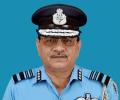
Speaking to reporters at an event here to mark the 75th anniversary of the Indian troops' Budgam landing, Air Officer Commanding in Chief (AOC-in-C) of Western Air Command, Air Marshal Amit Dev, also said the people in PoK are not being treated very fairly by the Pakistanis.

In a post on X, he said the people of Balochistan have given their "national verdict" and that the world must no longer stay silent.

The IAF had said that during the aerial engagement on February 27, one of its MiG-21 Bison shot down a F-16.
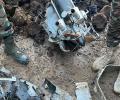
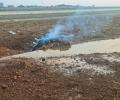
Local residents said a migrant labourer was injured in the incident, while a few houses in the area also sustained damage. Parts of the unidentified object were lying in the area, they said.
He then went on to say that, however, he won't get a Nobel Peace Prize for any of his efforts.
'Their (Pakistani) objective was to hit our army places. They could not and that is the bottom line'

IAF Chief Dhanoa and Abhinandan took a sortie on the MiG 21 jet from the Pathankot air base.

The Indian Air Force keeps moving its aircraft in both the Union Territories in the Northern sector including Jammu and Kashmir and Ladakh to give them the experience of flying there in their unique terrain.

Union Home Minister Amit Shah said on Friday that the Operation Sindoor undertaken by the Indian armed forces in retaliation for the Pahalgam terror attack has "completely exposed" the fact that terrorism in India is sponsored by Pakistan. Shah also said that the operation showed the "firm" political will of Prime Minister Narendra Modi, the "precise" intelligence inputs from agencies, and the "lethal" capabilities of the armed forces. He added that the operation was successful as it used the correct firepower and achieved its aims besides "showing the reality" to Pakistan.

Trump said that leaders in India and Pakistan are "great leaders" and "they understood, and they agreed, and that all stopped".

Defence sources that they were verifying reports that an F16 Pakistani jet had crashed in Lam Valley across the Line of Control.

'Fears in Washington began to intensify when it was realised that subsequent Pakistani and Indian attacks on major military facilities -- which were significant in terms of geographic scope and intensity -- could rapidly take both sides to where neither actually wanted to go.' 'The US objective was to stop the fighting as soon as possible. Everything else was secondary.'

The Pakistani president escaped death by a matter of seconds as his car drove over Lai bridge on December 14 last year.
